
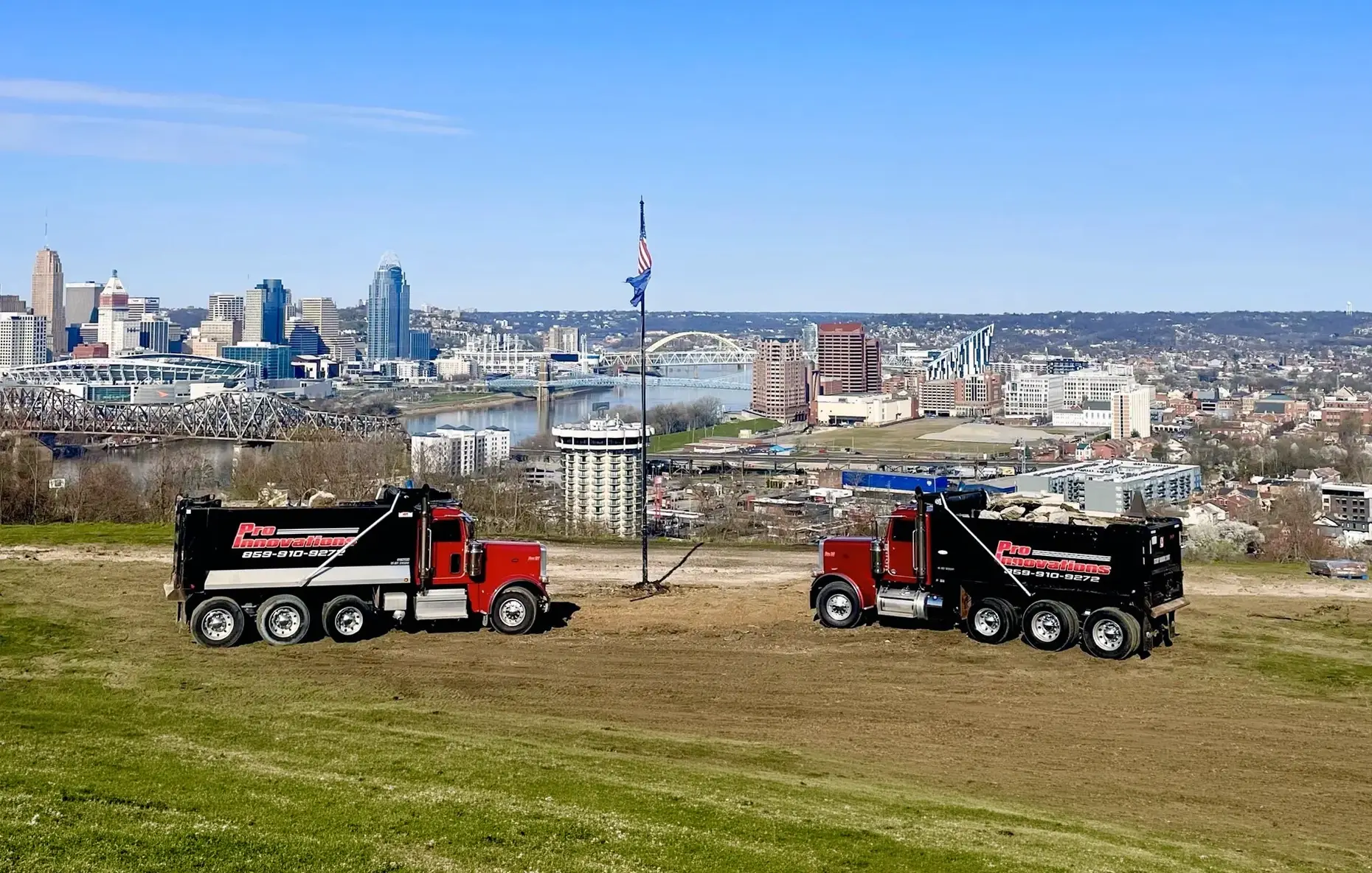
Triaxle fleet, ready to roll
Trucking and Material Delivery in Northern Kentucky
Most dirt work companies own a truck or two and rent the rest. Pro Innovations runs a triaxle dump fleet with our own drivers, based two minutes off I-75 exit 166 in Crittenden. That fleet is why our excavation, grading, and demolition jobs never sit waiting on a hauling sub, and it's available to you straight, whether you need one load of driveway gravel or trucks on a job site every day for a month.
The short answer
Pro Innovations delivers gravel, topsoil, sand, and fill dirt across Northern Kentucky and Greater Cincinnati with our own triaxle dump fleet, based two minutes off I-75 exit 166 in Crittenden. We're a registered motor carrier hauling for homeowners, builders, and contractors, and our grading crew can spread what we deliver. Call 859-910-9272.
Homeowners call us for gravel, topsoil, sand, and fill dirt dumped right where they want it. Builders and contractors call us when they need real hauling capacity on a schedule they can trust. Either way it's one call, one company, and material that shows up when we said it would.
When you need us
Your driveway is going back to mud
On our clay and fragipan ground, every wet season pushes gravel down and pulls mud up. When the ruts come back each spring, the answer is usually a real base and fresh stone, not another thin dressing.
The pile has to go
Spoil from a dig, concrete from a tear-out, brush and debris from a cleanup. If something on your property needs to leave, our trucks load out and haul off, no rented dumpster sitting in the yard for a month.
The project outgrew your pickup
A pickup bed carries about half a ton before the springs complain. Ten tons of stone is one dump truck or twenty pickup trips, and one of those options wrecks your Saturday.
Your site is waiting on trucks
For contractors, hauling capacity is schedule. When a brokered truck no-shows, your excavator sits and your crew burns hours. Fourteen trucks and our own drivers means we can actually commit.
What this covers
Gravel and stone delivery
#57 stone, crusher run, and driveway gravel delivered by the load across Grant County and the I-75 corridor. Tell us what the stone is for and we'll help you pick the right size.
Topsoil and fill dirt
Screened topsoil for lawns and gardens, fill dirt for holes, low spots, and pad building. We haul it in and dump it where your project needs it.
Sand delivery
Sand by the truckload for bedding pipe, setting pavers, arenas, and anything else that calls for it.
Dump truck hauling and haul-off
Spoil from a dig, debris from a tear-out, or material that just needs to leave. Our trucks load out and go.
Contractor hauling
Excavators, builders, and paving crews use our fleet when their own trucks run out. We're a registered motor carrier with the drivers to keep your site moving.
Multi-load supply for big jobs
Pads, long driveways, and subdivision work eat material fast. With a triaxle dump fleet we can cycle loads all day instead of trickling them in.
What moves the number
We quote after a site walk, not from a satellite photo. These are the honest variables.
The material itself
Quarry stone, screened topsoil, sand, and fill dirt each carry a different price at the source. Screened topsoil costs more than fill because it's processed; clean stone costs more than crusher run because it's washed and sized.
Tonnage and load count
Area times depth is the whole game. A driveway topping might be one load; a new pad or a long farm lane can be many. We'll do that math with you before anything rolls.
The haul distance
Trucking is time. How far the truck runs from the quarry or our yard to your site is a real part of the number, which is why being based on the I-75 corridor keeps our cycles short.
Access and the dump spot
A truck that can back straight in and dump is the cheap version. Tight turns, soft ground, low wires, and multiple dump spots all add time per load.
Dumped or spread
Dumped in a pile is the base service. If you want it spread, graded, and compacted, our own grading crew picks up where the truck leaves off, one contractor for both halves.
One load or a standing schedule
A single homeowner load and a contractor supply run priced per cycle are different arrangements. Recurring hauling gets planned so trucks and drivers stay productive, and that efficiency shows up in the rate.
Delivery materials at a glance
| Material | Best for | Rough coverage | Worth knowing |
|---|---|---|---|
| #57 stone | Driveway topping, drainage, pipe bedding | 1 ton covers about 80 to 100 sq ft at 2 in | Clean stone that drains; it stays loose and never compacts tight |
| Crusher run | Driveway base, parking pads | 1 ton covers about 50 sq ft at 4 in | The fines lock it into a tight, compactable base |
| Screened topsoil | New lawns, gardens, final grade | 1 cubic yard covers about 100 sq ft at 3 in | Runs roughly a ton per yard, more when it's wet |
| Fill dirt | Holes, low spots, building up grade | Figured by the load off your dimensions | Costs less than topsoil; it's structure, not a growing medium |
| Sand | Pipe bedding, paver bases, arenas | About 1.3 tons per cubic yard | Tell us the use and we'll send the right sand for it |
Rules of thumb, not a quote. Give us your dimensions and we'll figure the loads with you: 859-910-9272.
Crusher run or #57 stone?
The two most requested gravels do completely different jobs, and putting the wrong one down is how driveways fail early. Here is the honest split.
Crusher run
Best for: The base layer. New driveways, parking pads, and soft spots that need to firm up. The mix of crushed stone and fines compacts into a tight surface that holds together under a tire.
The trade: Those same fines mean it doesn't drain like clean stone, and on steep grades hard rain can wash them. It wants to be compacted and crowned, then topped.
#57 stone
Best for: The top dressing on an established drive, plus french drains, culvert bedding, and anywhere water needs to move through the stone instead of sitting in it.
The trade: Clean stone never locks together. Dumped straight on dirt or mud it rolls, scatters, and sinks, so it belongs over a compacted base, not instead of one.
How the job runs
01
Tell us what and where
Material, rough quantity, and the delivery spot. Not sure how many loads you need? Give us the dimensions and we'll do the math with you.
02
Get a straight answer
We confirm the material, the load count, and the delivery window before anything rolls. No guessing on either side.
03
We deliver
The truck dumps exactly where you want it, within what the ground and the access allow. Our drivers have backed into plenty of tight Kentucky driveways.
04
Need it spread?
This is where owning the whole toolbox pays off. Our grading crew can spread and finish what our trucks just delivered, so you're not raking out ten tons by hand.
Single loads usually land within a few days of your call, sooner when a truck is already running your direction, and spring driveway season is the busiest stretch of our year, so calling ahead of the ruts helps. Multi-load supply for pads and site work gets scheduled around your project, and with a triaxle dump fleet we can cycle loads all day instead of trickling them in. The one honest caveat is ground condition: if your dump spot is off the pavement and the ground is saturated, we'd rather wait a day or two than bury a truck in your yard.
triaxle dump fleet
The heart of the service: stone, topsoil, sand, and fill in, spoil and debris out, dispatched by us instead of a broker.
Articulated dump trucks
Off-road haulers that carry material across soft or steep ground where a road truck would bury itself to the axles.
Excavators and track loaders
Loading out spoil and debris fast, so haul-off jobs never stall at the pile.
Skid steers
Spotting material into tight corners after the truck dumps, and moving loads the last hundred feet a truck can't.
Dozers and rollers
When the delivery becomes a driveway or a pad, the grading crew finishes what the trucks started.
Pro Innovations is a registered motor carrier, USDOT 3265041, MC 1029863, running a triaxle dump fleet with our own drivers out of Crittenden. It's the same fleet that hauls for our own excavation and demolition crews every day, which means the trucks, the drivers, and the dispatch are ours, not brokered out.
Built for Kentucky ground
Northern Kentucky averages roughly 43 to 45 inches of rain a year, and the ground here is famously bad at taking it in. The ridgetop soils along the I-75 corridor, Nicholson and Rossmoyne, carry a dense fragipan a couple feet down that perches water near the surface all winter and spring, and the Eden clay on the slopes sits just 20 to 40 inches over shale. For a gravel driveway that's the whole story: every wet-season tire pass pumps stone down into saturated clay, which is why drives out here eat gravel and why the real fix is a compacted crusher run base with clean stone on top, not another thin dressing over mud.
Delivering on this terrain is its own skill. Local relief runs 150 to 300 feet from ridgetop to creek in Grant County, a loaded dump truck is a serious amount of weight, and wet Eden clay won't carry it, so our drivers read the ground before they leave the pavement. On soft or steep sites our articulated trucks bridge the gap between the road and where the material actually needs to land. And on this region's slip-prone shale hillsides, where the pile goes matters as much as what's in it: fill dumped at the top of a saturated slope is how ground starts moving, so we spot loads where the ground can take them.
Questions we hear a lot
What materials do you deliver?
Gravel and stone, including #57 and crusher run, plus topsoil, sand, and fill dirt. If you're not sure what your project calls for, describe it and we'll steer you to the right material and the right amount.
How much gravel do I need for my driveway?
It depends on length, width, and how much base is already down. As a starting point, give us the driveway's rough dimensions when you call and we'll figure the loads with you, so you're not paying for stone you don't need.
How much does gravel delivery cost in Northern Kentucky?
The price is built from three things: what the material costs at the source, how many tons you need, and how far the truck runs. We don't pad any of them. Give us the project and we'll quote the whole thing, delivery and spreading included if you want it.
What is the difference between crusher run and #57 gravel?
Crusher run is crushed stone mixed with fines, so it compacts into a tight base that holds together under traffic. #57 is clean, uniform stone that drains freely but never locks up. Base with crusher run, top with #57, and use #57 alone for drainage work.
How many square feet does a ton of gravel cover?
A ton of #57 covers about 80 to 100 square feet at 2 inches deep, and roughly half that at 4 inches. Measure your length and width, tell us how thick you want it, and we'll turn that into an exact load count.
Do you haul for other contractors and builders?
Yes. We're a registered motor carrier (USDOT 3265041, MC 1029863) running a triaxle dump fleet with our own drivers, and contractor hauling is a regular part of our week. If your job needs trucks, we can put real capacity on it.
Can you spread the material after you deliver it?
We can. Our own grading crew spreads and finishes driveways, pads, and yards, so the delivery and the dirt work come from one contractor instead of two.
How far will you deliver?
We're based in Crittenden, two minutes off I-75 exit 166, and we deliver throughout Grant County, Northern Kentucky, and Greater Cincinnati. If you're anywhere along that corridor, we can get a truck to you.
How many tons does a dump truck hold?
It depends on the truck and the material. A tri-axle dump truck typically hauls around 15 to 16 tons, and light, bulky materials like topsoil can fill the bed before they reach the weight limit. Tell us what you're covering and we'll translate it into loads.
When is the best time of year to gravel a driveway in Kentucky?
Most calls come in spring, when the ruts show up. The best work happens in dry late summer and fall, when the base compacts properly and the trucks aren't fighting soft ground. Stone put down before winter beats fixing mud in March every time.
Can a dump truck get into a tight driveway?
Usually, and our drivers have threaded plenty of them. Where a loaded truck genuinely can't reach the spot, or would rut a soft lawn getting there, we can dump where the ground holds and move material the rest of the way with a skid steer. We'll talk through your access before the truck rolls.
Trucking & Material Delivery near you
Local pages for the towns where this work keeps our crews busiest.
Often paired with
Ready to talk trucking & material delivery?
Walk us through the project and we'll walk the site. Straight answers, firm numbers, one contractor.