
Dirt work done right
Excavation Contractors for Northern Kentucky
When the plans call for moving earth, this is the crew that shows up with the equipment to actually move it. Pro Innovations has been digging basements, cutting building pads, and shaping ground across Northern Kentucky and Greater Cincinnati for over 35 years.
The short answer
Pro Innovations is an excavation contractor based in Crittenden, Kentucky, serving Northern Kentucky and Greater Cincinnati for over 35 years. We dig basements, foundations, ponds, and building pads, run our own excavators and dozers, and haul spoil and stone with our own triaxle dump fleet. Call 859-910-9272 for a site walk and a firm number.
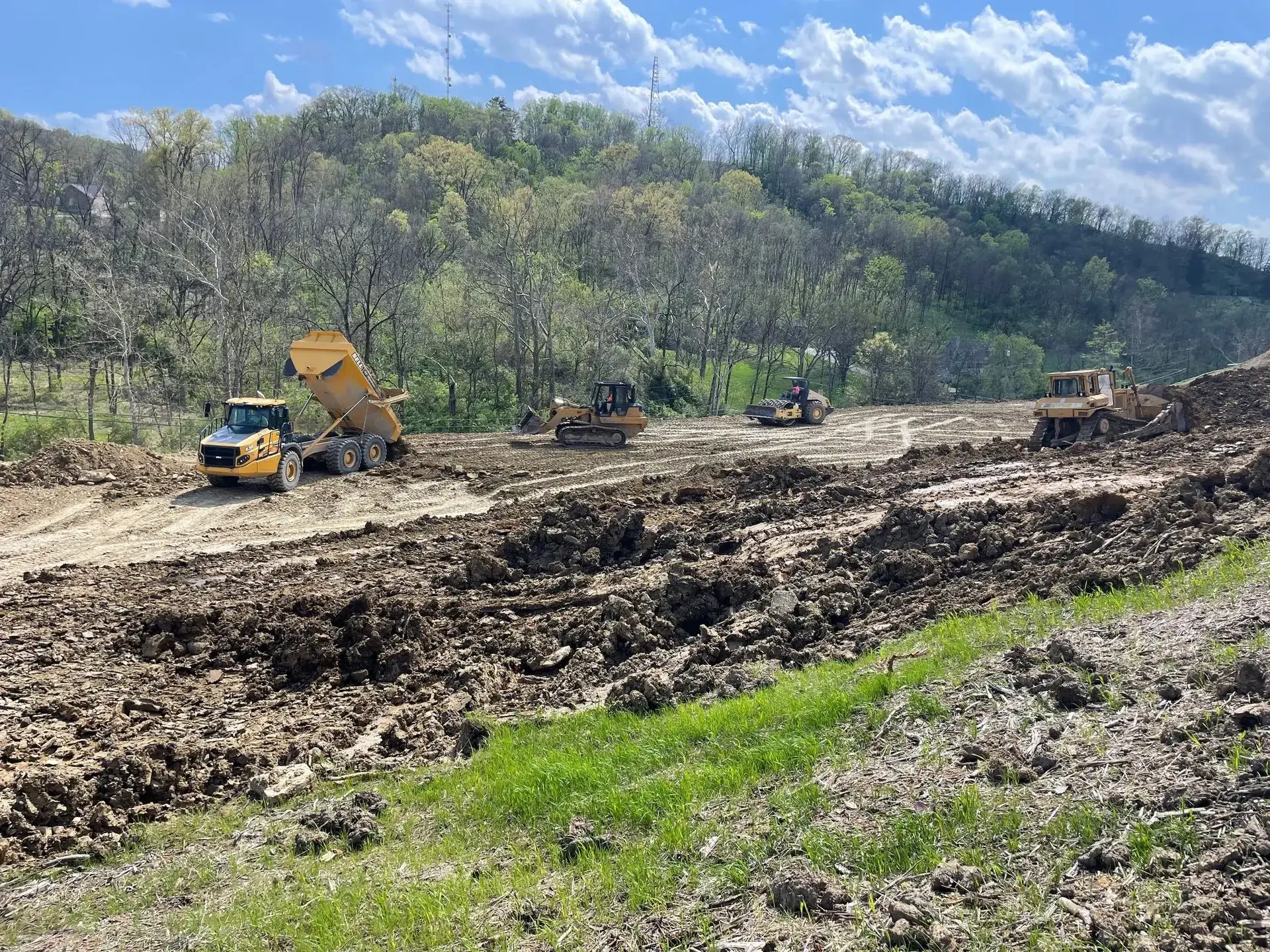
We run our own excavators, dozers, articulated trucks, and rollers, and our own dump fleet hauls the spoil away and the stone back in. That means your dig, your hauling, and your finish grade are one contractor and one schedule, not three subs pointing at each other.
When you need us
You're building on a sloped lot
Most buildable land left in Northern Kentucky has fall to it. A sloped lot needs a planned cut, engineered fill, and somewhere for the water to go before a footer is ever poured.
Your builder needs a pad date
Framing crews book weeks out. When the dig slips, everything behind it slips. Because we run our own iron and trucks, our schedule is the only one your dig depends on.
You want a basement, not a crawl space
A walkout basement on Kentucky hill ground is one of the best value adds there is, and it starts as an excavation decision, not a framing one.
Water is already winning
If a low spot, a failing culvert, or a saturated slope is on the property, the dig has to solve it, not just work around it.
What this covers
Basement and foundation digs
Precise cuts to plan elevation for new homes and additions, with spoil hauled off or bermed on site the way your builder wants it.
Building pads
House pads, barn pads, and barndominium pads cut, filled, and compacted to hold what you're building on them.
Pond building
Dug ponds and dam-built ponds shaped for the way water actually moves through your property.
Trenching and culverts
Utility trenches, driveway culverts, and creek crossings that keep water where it belongs.
Cut and fill earthwork
Balancing a sloped site so you're not paying to haul dirt both directions.
Haul-off and haul-in
Our own trucks handle spoil removal and deliver stone, fill, and topsoil back to the site.
What moves the number
We quote after a site walk, not from a satellite photo. These are the honest variables.
The dirt itself
A yard of dry clay and a yard of saturated shale don't move the same. Rock, wet ground, and slip-prone soils change equipment, time, and how much material can be reused.
Depth and elevation change
A flat-lot footer dig and a 10-foot walkout cut into a hillside are different jobs. More vertical means more material, more benching, and more compaction.
Access
Tight lots, soft ground, buried utilities, and overhead lines decide which machines fit and how fast trucks can cycle.
Spoil: keep it or haul it
Hauling is real money. When the site allows, we balance cut and fill on your property so you keep the material and skip the trucking.
What the job connects to
If the dig ties into utilities, drainage, a driveway, or a finish grade, bundling it with one contractor is cheaper than mobilizing three.
Common digs and what they involve
| Project | Typical depth | Usual crew and iron | What decides the price |
|---|---|---|---|
| Walkout basement | 8 to 10 ft on the cut side | Excavator, dozer, trucks | Slope, rock, spoil plan |
| Crawl space / footer | 2 to 4 ft | Excavator, compactor | Access, soil bearing |
| Farm pond | 8 to 15 ft at the deep end | Excavator, dozer | Soil type, dam vs dug, size |
| Driveway culvert | 2 to 4 ft | Excavator, trucks for stone | Pipe size, road tie-in |
| Utility trench | 2 to 6 ft | Excavator or trencher | Length, depth, restoration |
Every site is different. This is orientation, not a quote: call 859-910-9272 for a number on your project.
Balance on site or haul it off?
Every dig produces spoil, and what happens to it is one of the biggest line items on the quote. There are two honest answers, and the right one depends on your property.
Balance on site
Best for: Larger lots with somewhere useful to put material: building up a pad, filling a low area, shaping a yard.
The trade: Needs space and a use for the dirt. Badly placed spoil becomes tomorrow's drainage problem, so it gets graded and compacted, not just dumped.
Haul off
Best for: Tight lots, contaminated or unsuitable material, and digs where every yard has to leave.
The trade: You pay for trucking, which is why our own fleet matters: no third-party hauling markup and no waiting on someone else's trucks.
How the job runs
01
Walk the site
We look at access, slopes, water, and utilities before we quote, so the number you get is the number the job costs.
02
Plan the dig
Elevations, spoil handling, and trucking get planned up front. Utility locates are called in before a bucket touches dirt.
03
Move the earth
The right machines for the site, run by operators who have been reading Kentucky ground for decades.
04
Leave it finished
Grade checked, site cleaned, and ready for the next trade, or seeded and strawed if we're the last one out.
Most residential digs run one to three days once we mobilize: a footer or culvert is usually a day, a full walkout basement two to three, and a pond somewhere between depending on size and how the soil cooperates. The honest variable is weather. We won't cut your site into mud that costs you more to fix than the wait would have.
Excavators
The primary dig: basements, footers, ponds, trenches.
Dozers
Cuts, pads, benching, and pushing material where it needs to live.
Articulated dump trucks
Moving spoil across soft or steep ground a road truck can't touch.
Rollers and compactors
Fill that holds a building up, compacted in lifts, not dumped in one.
triaxle dump fleet
Spoil out, stone and fill in, on our schedule instead of a hauling sub's.
Excavation is the core of what Pro Innovations does. We run our own excavators, dozers, and compaction equipment, backed by a triaxle dump fleet, so the dig never waits on a rental yard or a hauling sub.
Built for Kentucky ground
Northern Kentucky sits on the Eden shale belt, and anyone who has dug here knows what that means: clay-heavy soils over shale that hold water in the winter, slip on saturated slopes, and turn to concrete in an August drought. Digging this ground well is a local skill. Cut a hillside wrong and it moves; compact fill wrong and the building on top of it settles.
That's why our digs are planned around water first. Where the spoil goes, how the cut sheds rain before the build closes in, and whether a slope needs benching are decisions we make from 35 years of watching this specific dirt behave.
Questions we hear a lot
How much does excavation cost in Northern Kentucky?
It depends on the dirt, the depth, and the access, which is why we walk every site before we quote. What we can promise is a firm number up front, and that one crew handles the dig, the hauling, and the grade so there are no surprise sub invoices.
Do you handle utility locates before digging?
Always. Kentucky 811 locates get called in before any dig, and we plan trenches and cuts around what's marked.
Can you dig a pond on my property?
Yes. Ponds are some of our favorite work in Grant County and the surrounding counties. We look at your soil and drainage first, because a pond that holds water starts with the right site, not just a big hole.
Do you do small residential digs or only large sites?
Both. The same company that cuts full building sites will dig your walkout basement, your driveway culvert, or the footer for your addition. No job has to be big to be done right.
Will you haul away the dirt from my excavation?
Yes, with our own trucks. Depending on the site we can also balance the cut on your property so you keep the material and skip the trucking cost.
How deep can you dig a basement?
A full walkout runs 8 to 10 feet on the cut side, and we routinely go deeper for special foundations. On our shale ground the honest limit is usually rock and water, not the machine, which is why we look before we promise.
What is the best time of year for excavation in Kentucky?
Late spring through fall is prime digging: the clay is workable and compaction tests pass. Winter digs are possible, but saturated Eden shale ground slips and ruts, so some jobs are genuinely cheaper to schedule than to force.
Do you dig utility trenches and driveway culverts?
Yes, both. Utility trenches get cut to the depth the utility calls for, bedded under the pipe, and backfilled in lifts so the ground over them doesn't settle later. Culverts get sized and set to the road tie-in, with the stone hauled in on our own trucks.
Can you work on steep or hard-to-reach sites?
That's most of our portfolio. Articulated trucks and dozers exist for exactly the sites a road truck can't touch, and benching a steep cut safely is the kind of judgment 35 years in this ground buys.
How far will you travel for an excavation job?
Our yard sits two minutes off I-75 in Crittenden, and we work the whole corridor: Grant, Boone, Kenton, Campbell, Pendleton, Bracken, Owen, and Gallatin counties, up through Independence and Florence. If you're within an hour of the yard, call, and the answer is probably yes.
Excavation near you
Local pages for the towns where this work keeps our crews busiest.
Often paired with
Ready to talk excavation?
Walk us through the project and we'll walk the site. Straight answers, firm numbers, one contractor.