
From raw ground to ready to build
Site Development and Utilities in Northern Kentucky
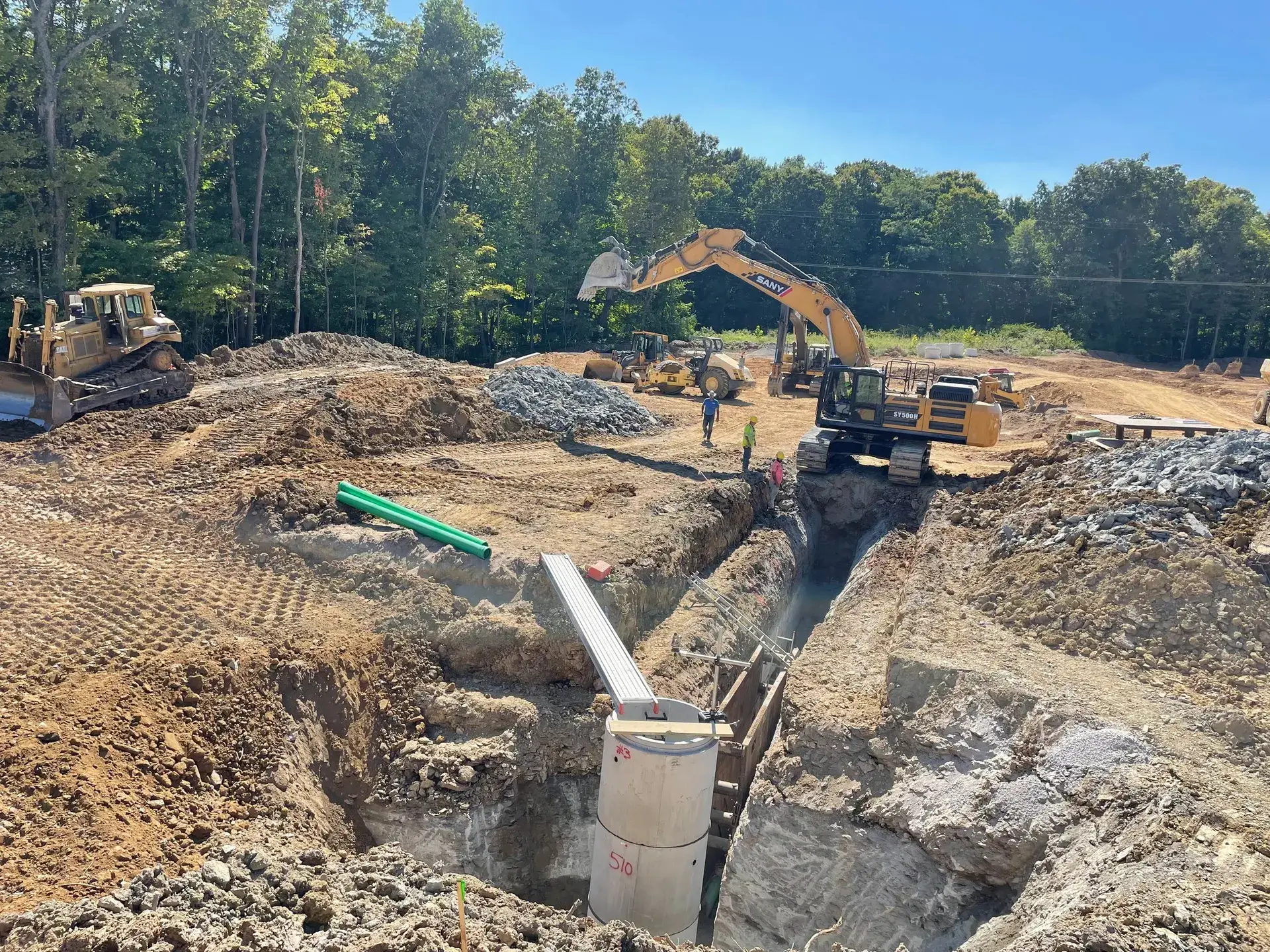
Between a raw piece of ground and a foundation, there's a long list of work: clearing, a pad at the right elevation, trenches for water and sewer, a driveway the concrete trucks can actually climb. Most people end up scheduling three or four contractors to get through that list. We're one call for all of it.
The short answer
Pro Innovations takes Northern Kentucky land from raw ground to build-ready: clearing, house and barndominium pads, utility trenches, water and sewer service lines, footer drains, and stone construction drives. One contractor with our own equipment and triaxle dump fleet, based in Crittenden for over 35 years. Call 859-910-9272 for a site walk.
Pro Innovations has spent over 35 years turning Northern Kentucky ground into buildable sites, from single lots off a county road in Grant County to builder work in the subdivisions growing along the I-75 corridor. We own the excavators, dozers, and compaction equipment, and our own dump fleet brings the stone in and takes the spoil out, so the site never sits waiting on somebody else's schedule.
Whether you're a builder who needs lots turned fast or a family putting a house or barndominium on land you just bought, the goal is the same. When we pull off, the site is ready for the next trade to go straight to work.
When you need us
You bought land and don't know the order of operations
Raw acreage comes with a sequence: clear, strip, pad, trenches, drive. Getting it in the wrong order costs money twice. We run the whole sequence, so you make one call instead of learning sitework the expensive way.
Your builder gave you a date
Foundation crews book out, and the pad, the utilities, and the access all have to land before they show up. When one contractor owns the whole scope and the trucks, there's no gap between trades for the schedule to fall into.
The build sits a long way off the road
A house set back on acreage means a long drive and long utility runs. Those get planned and priced up front, because every foot of trench and every load of stone is real money.
The ground won't drain itself
A lot of the best land in Grant, Pendleton, Owen, and southern Boone County sits on ridgetop clay over a dense pan that perches water right where footers and basements go. The pad gets shaped to shed water from the first pass, and the drains go in while the trenches are still open.
What this covers
Lot and site preparation
Clearing, stripping, and rough grading that take a lot from raw ground to a workable site, with topsoil stockpiled for the finish grade.
House and barndominium pads
Pads cut, filled, and compacted to the elevation on your plans. A pad done right is cheap insurance for everything you build on top of it.
Utility trenches
Trenching for water, sewer, electric conduit, and gas runs, cut to depth, bedded properly, and backfilled and compacted so the yard doesn't settle over them later.
Water and sewer lines
Service lines run from the connection point to the house, sloped and bedded the way inspectors want to see them.
Storm and footer drains
Foundation drains, curtain drains, and downspout lines piped to daylight while the trenches are already open, so water leaves the pad instead of standing against it.
Builder lot development
Repeat sitework for builders across subdivision lots, on a schedule you can put in front of your buyers with a straight face.
Construction access and driveways
Stone entrances and driveway cuts built early, so concrete trucks, lumber deliveries, and trades get in and out through every phase, in any weather.
What moves the number
We quote after a site walk, not from a satellite photo. These are the honest variables.
Distance to the taps
Every foot between your build and the water, sewer, electric, and gas connection points is trench to cut, bed, and backfill. A lot with utilities at the road prices very differently than a build site 600 feet back.
What the trench hits
Parts of this region have limestone 20 to 40 inches down, and some ground has rock even shallower. Shale, rock, and saturated clay all change the digging, and finding out at the site walk beats finding out mid-trench.
How much elevation the pad makes up
A pad near natural grade is shaping. A pad that needs several feet of fill is engineered lifts, compaction, and truckloads of material. Slope is the biggest single swing on a site development quote.
Access for trucks
Stone, fill, and spoil move by the truckload, so how fast trucks can get in, turn, and cycle affects the whole job. Building the stone entrance first usually pays for itself.
How many contractors you'd otherwise hire
Split the scope across a clearing crew, an excavator, a utility sub, and a hauler and you pay four mobilizations plus the dead days between them. One contractor, one mobilization, one schedule.
The finish you want at handoff
Some sites hand off at rough grade for the builder. Others want topsoil respread, finish grading, and seed and straw so the lot is done. We price the finish you actually want.
Utility runs at a glance
| Run | Typical cover | Bedding and backfill | What governs it |
|---|---|---|---|
| Water service line | 30 to 48 in, always below frost | Sand or fine bedding, compacted backfill | Water district spec and frost depth |
| Sewer lateral (gravity) | Depth set by the tap | Stone bedding, fall of about 1/4 in per foot | Plumbing code and the main's depth |
| Electric service | 18 in in conduit, 24 in direct burial | Clean fill, warning tape above | NEC minimums and the power utility |
| Gas service line | 18 to 24 in typical | Sand bedding, tracer wire | The gas utility's spec |
| Footer and foundation drain | At footer level, below the slab | Washed stone around the pipe, fabric over the stone | Building code and fall to a daylight outlet |
Typical figures for this region, not a design. Your utility's spec and your inspector govern. Call 859-910-9272 to scope your actual runs.
Cut the pad in or build it up?
On sloped ground, a building pad gets made one of two ways: cut into the hillside, or built up on compacted fill. Most sites use some of both, but which way the balance tips changes the cost, the schedule, and how the site handles water.
Cut into the slope
Best for: Sites with enough hill to bench into, walkout basements, and ground where the cut material is good enough to reuse elsewhere on the lot.
The trade: You're digging into native ground, which can mean rock or wet shale, and the cut face above the pad has to be laid back or benched and drained so it stays put.
Build up on fill
Best for: Low or gently sloped sites, flood-shy building spots, and pads that need to come up to meet a driveway or a finished floor elevation.
The trade: Fill is only as good as its compaction. It goes in as controlled, compacted lifts with moisture managed, or the building on top settles. Big fills also mean real trucking.
How the job runs
01
Walk the land with your plans
We look at slopes, soil, water, access, and where the utilities have to come from before we price anything.
02
One quote, whole scope
Pad, trenches, driveway, hauling. It's priced as one job so you're not stacking sub quotes and hoping they add up.
03
Open the site
Clearing and stripping first, with Kentucky 811 locates called in before any trench gets cut.
04
Pad, trenches, and stone
The pad goes to grade and gets compacted, utility runs go in, and our trucks deliver the stone for the drive and the staging areas.
05
Hand it off build-ready
You get a site your builder, foundation crew, and inspectors can work from. If we're also pouring your flat work or digging your foundation, there's no handoff at all.
A single-lot package, clearing through pad, trenches, and stone drive, usually runs one to two weeks of actual work on site. The calendar spreads wider than that, because utility taps, locates, and inspections all have their own clocks, so we sequence the dirt work around them instead of letting the site sit torn open. Weather is the honest variable on clay ground: we won't cut trenches or place fill in saturated soil that will cost you settlement later. Builders running multiple lots get a rolling schedule, one lot finishing while the next opens.
Excavators
Utility trenches, tank holes, and the cut side of every pad.
Dozers
Stripping, rough grading, and pushing pads to plan elevation.
Track loaders and skid steers
Bedding stone, backfill, and the tight work around trenches and foundations.
Rollers and compactors
Pad fill and trench backfill placed in lifts that won't settle under your slab or your yard.
triaxle dump fleet
Stone and fill in, spoil out, without waiting on a third-party hauler.
Site development rewards owning the equipment, and we do: excavators, dozers, articulated dump trucks, track loaders, and rollers, backed by a triaxle dump fleet with our own drivers running as a registered motor carrier. When the pad needs 40 loads of fill, we're not calling around for trucks. They're ours.
Built for Kentucky ground
The two soils that define Northern Kentucky building sites work against the two things site development has to deliver: a dry pad and a stable trench. On the ridgetops where most lots get laid out, series like Nicholson and Rossmoyne carry a dense fragipan 16 to 30 inches down. Water can't soak through it, so a seasonal water table perches in exactly the zone where footers, basements, and foundation drains want to live. A pad on that ground gets graded to shed water from the first pass, with curtain drains and downspouts piped to daylight, because the pan guarantees the site will never drain itself.
Off the ridges, the Kope Formation takes over, roughly 75 percent soft shale that weathers into the clay colluvium behind this region's national reputation for landslides. Bedrock sits just 20 to 40 inches down in Eden ground, so deeper trenches and pad cuts meet shale, and clay fill placed wet is how driveways crack and pads creep downhill. With 43 to 45 inches of rain a year falling on ground that can't absorb it, we treat every pad and trench as a water management problem first: fill compacted in controlled lifts, cuts benched and drained, and roof and surface water routed away from anything we built.
Questions we hear a lot
What does site development include?
Everything between raw land and a buildable site: clearing, rough grading, the building pad, utility trenches, water and sewer lines, footer drains, and a stone construction drive. You can hire us for one piece or hand us the whole scope.
Do you install water and sewer lines?
Yes. We trench, bed, and run service lines from the connection point to your build, then backfill and compact so the ground over them stays put.
Do you install footer and foundation drains?
Yes, and on this ground it isn't optional. Ridgetop clay perches water right at footer depth, so the foundation drain goes in with washed stone and fabric over it, curtain drains catch what runs downhill, and downspouts get piped to daylight instead of dumping against the pad we just built.
How deep are water and sewer lines buried in Kentucky?
Water services go below the frost line, which typically means 30 to 48 inches of cover here, per your water district's spec. Gravity sewer depth is set by the tap you're connecting to, with the lateral falling about a quarter inch per foot on its way there. We trench to whatever the utility and the inspector call for.
Can you prepare a site for a barndominium?
Absolutely, and we build a lot of them in Grant County and the rural counties around it. A barndo pad carries different loads than a stick-built house, so we cut, fill, and compact it for the building that's actually going on it.
Do you develop lots for builders?
Yes. Builders use us because one crew handles the pad, the utilities, and the trucking across multiple lots, and the schedule holds because none of it depends on an outside hauler or a rental yard.
What is the difference between site preparation and excavation?
Excavation is the digging: basements, ponds, trenches. Site preparation is the whole package that makes a lot buildable, and excavation is one piece of it alongside clearing, grading, utilities, and access. If your project is a dig, see our excavation page. If it's raw land to build-ready, this is the service.
Can you put in a driveway before construction starts?
That's usually the first thing we build. A stone construction entrance keeps concrete trucks and deliveries moving in any weather, and it becomes the base for your finish driveway instead of wasted money.
Do you clear wooded lots as part of site development?
Yes. Clearing, grubbing, and stripping are the front end of most site packages, and because our own trucks haul the debris and the spoil, the lot goes from woods to workable without a second contractor in the mix.
How long before my site is ready to build on?
It depends on the lot, but running the whole scope through one contractor is the fastest version of this job. There's no dead week waiting for the trenching sub to follow the grading sub. We sequence it, and the site moves every day until it's done.
Site Development & Utilities near you
Local pages for the towns where this work keeps our crews busiest.
Often paired with
Ready to talk site development & utilities?
Walk us through the project and we'll walk the site. Straight answers, firm numbers, one contractor.