
From overgrown to open
Land Clearing in Northern Kentucky
Kentucky ground grows back fast. Give a fence row five years and it's a wall of honeysuckle and cedar. Give a back lot ten and you can't walk it. Whether you're clearing a homesite, opening up acreage you just bought, or taking a pasture back from the brush, we clear it and leave it ready for whatever comes next.
The short answer
Pro Innovations clears land across Northern Kentucky and Greater Cincinnati: lot and homesite clearing, forestry mulching, brush hogging, fence lines, and pasture reclamation. Based in Crittenden with our own track loaders, dozers, excavators, and a triaxle dump fleet, one crew takes your ground from overgrown to build-ready. Call 859-910-9272 for a site walk.
Pro Innovations has been working this ground for over 35 years, and clearing is where a lot of our jobs start. Because we're a one-stop shop, the same crew that drops the trees can grade the site, cut the driveway, and seed it behind us. You make one call and the land goes from overgrown to build-ready without a handoff between contractors.
When you need us
You bought land you can't walk
New acreage often comes with years of growth nobody managed. Until it's opened up you can't see the lines, lay out a homesite, or even know what you have. Clearing is how the property becomes yours in practice, not just on paper.
The fence row became a tree row
Honeysuckle and cedar turn a fence line into a hedge you can't service. Once posts and wire disappear into the growth, repairs stop happening and the line keeps creeping into the field.
Pasture is going back to scrub
Cedar and locust move into unmowed grass in just a few seasons. Catch it early and it's a brush hogging job. Wait a decade and it's full reclamation with stumps. The sooner you call, the cheaper the fix.
A build is waiting on the brush
A house, barn, or driveway can't get laid out on ground nobody can see. Clearing is the first trade on almost every build, and because we also do the pad, grading, and utilities, it doesn't have to be a separate contractor.
What this covers
Lot and homesite clearing
Trees, brush, and undergrowth taken down and cleaned up so a building site is actually visible, walkable, and ready to lay out.
Forestry mulching
Grinding brush and small trees in place, turning overgrowth into a mulch layer that holds the soil. No burn piles, no haul-off, minimal ground disturbance.
Brush hogging
Fields, back lots, and rough acreage knocked down and kept down. A once-a-year cut is a lot cheaper than a reclamation job.
Fence line clearing
Fence rows opened back up so you can build, repair, or actually see your property line. We clear tight to the line without tearing up the pasture beside it.
Tree and stump removal
Selective take-downs or full clearing, with stumps ground or dug out so they don't come back up through your new lawn, driveway, or pad.
Pasture reclamation
Cedar, locust, and brush pushed out of grown-over pasture so the ground can go back to grazing or hay instead of scrub.
What moves the number
We quote after a site walk, not from a satellite photo. These are the honest variables.
What's growing on it
An acre of waist-high brush and an acre of mature mixed timber are different jobs by an order of magnitude. Density, trunk size, and how much of it is thorny or vined all move the number.
Slope and access
Flat, open ground clears fast. Steep hillsides, soft draws, and parcels with no drive-in access slow the equipment down and can change which machines we bring at all.
The method
Mulching in place skips hauling and cleanup but leaves roots. Push-and-pile clearing gets everything out but creates material to deal with. The right choice depends on what the land is for next.
Stumps: leave, grind, or dig
Stumps can stay under a pasture, get ground below grade under a lawn, or need digging out entirely under a pad or driveway. Each level is more work than the last.
Where the material goes
Hauling brush and logs off site is real trucking. Our own fleet keeps that cost in-house, and mulching or on-site piling can remove it altogether when the property allows.
How finished you want it
Some customers want the growth knocked down and nothing more. Others want stumps out, ground rough graded, and seed and straw behind us. The end state you pick sets the scope.
Which clearing method fits the growth
| Method | Handles | Ground disturbance | What's left behind |
|---|---|---|---|
| Brush hogging | Grass, weeds, saplings up to about 2 in | Minimal | Cut material lays where it falls |
| Forestry mulching | Brush and trees up to about 6 to 8 in | Low, roots stay in the ground | Mulch layer that protects the soil |
| Push and pile (dozer) | Mature trees and heavy overgrowth | High, roots and stumps come out | Piles to haul off, ground ready for grading |
| Cut, grind, and haul | Selective take-downs, tight sites | Moderate | Clean site with stumps ground below grade |
| Stump digging | Stumps under future pads and drives | Localized | Holes backfilled and compacted |
Rough guide, not a quote. Most properties end up using more than one method, and a site walk settles it: 859-910-9272.
Forestry mulching or dozer clearing?
The two main ways to clear land solve different problems, and picking the wrong one either costs you money or leaves the ground wrong for what comes next. Here's the honest split.
Forestry mulching
Best for: Overgrown pasture, fence lines, trails, view corridors, and hillsides where the roots should stay in the ground holding the slope.
The trade: Stumps and roots stay put, so it's not the answer under a future pad, driveway, or finished lawn. Heavy timber is slow going for a mulcher, and slow is expensive.
Dozer and excavator clearing
Best for: Ground that's getting built on, graded, or returned to clean pasture: homesites, building pads, driveways, and full reclamation with stumps out.
The trade: More ground disturbance and more material to handle, so it comes with a plan for piling, hauling, and stabilizing the bare dirt before the weather gets to it.
How the job runs
01
Tell us the end goal
A homesite, a pasture, a pond view, a clean fence row. What the land is for decides how we clear it, so that's the first question we ask.
02
Walk it together
We flag what stays and what goes, tree by tree if you want. You won't lose an oak you cared about because nobody asked.
03
Clear it
Mulch it in place, push and pile it, or cut and haul it off. We match the method to the ground, the slope, and your budget.
04
Leave it usable
Cleared ground gets rough graded so it drains and you can drive it. If you want it finish graded and seeded, we do that too, same crew, same trip.
Brush hogging moves fast, and several acres can fall in a day. Forestry mulching typically covers one to a few acres a day depending on how thick the growth is. Full clearing for a homesite, with trees down, stumps out, and material hauled, usually runs a couple of days to a week or more depending on size. The wildcard is wet clay: if the ground can't carry equipment without tearing up, we'll say so, because forcing it costs you more in repair grading than the wait would.
Track loaders and skid steers
The mulching and brush work: grinding overgrowth in place, working tight to fence lines, and cleaning up where bigger iron can't maneuver.
Excavators
Selective take-downs, digging stumps, piling material, and pulling root balls out of ground that's getting built on.
Dozers
Pushing heavy growth, stacking piles, and rough grading cleared ground so it drains and drives.
triaxle dump fleet
Hauling off brush, logs, and stumps on our schedule, with no third-party hauling sub in the middle.
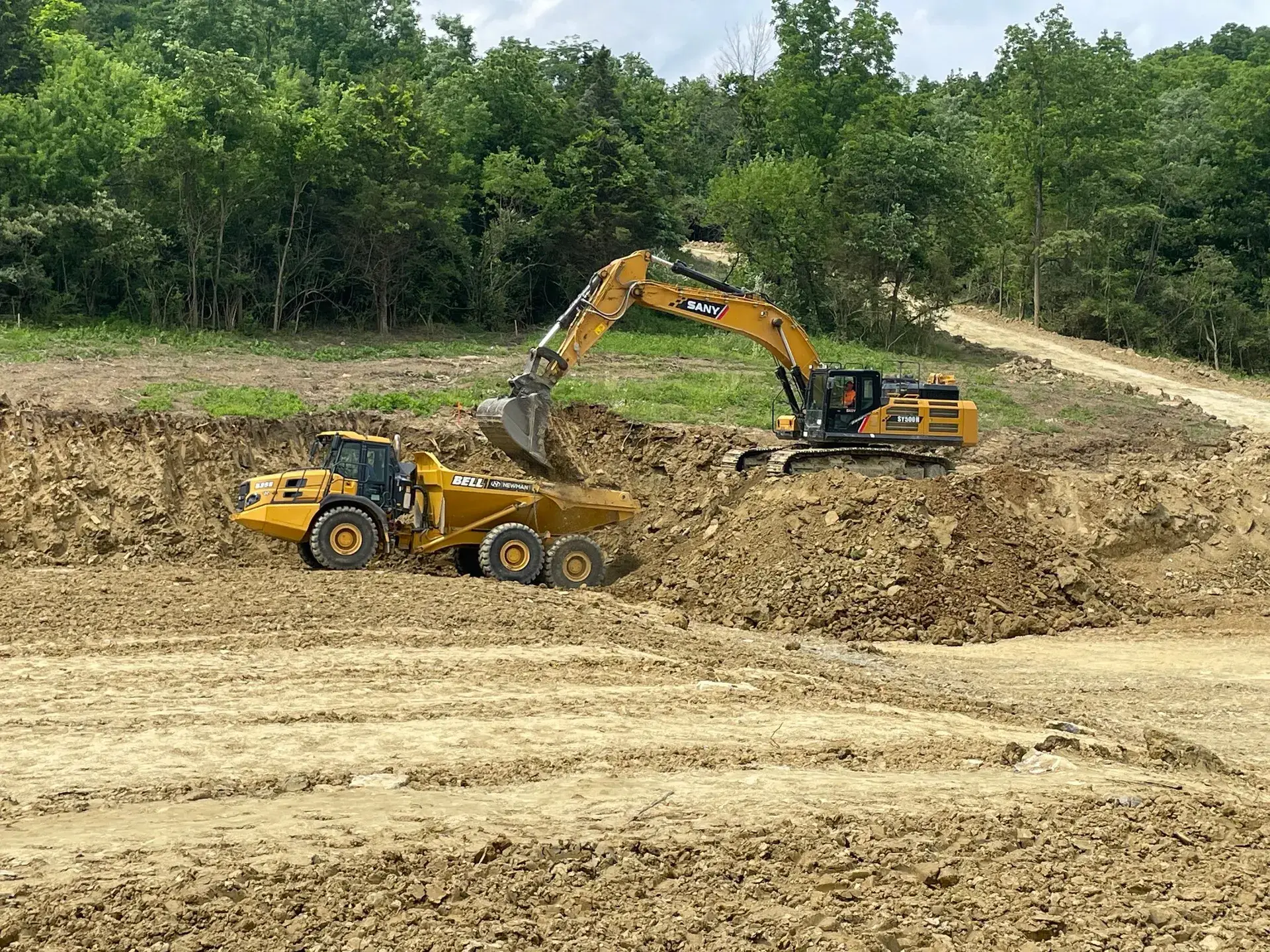
We clear with our own track loaders, skid steers, excavators, and dozers, and our triaxle dump fleet hauls off whatever doesn't get mulched in place. That's why we can take on everything from a half-acre fence row in Grant County to full-parcel clearing along the I-75 corridor without waiting on rented iron or a hauling sub.
Built for Kentucky ground
Clearing here is shaped by what this ground does when you take the cover off it. Northern Kentucky's hillsides sit on the Kope Formation, a soft shale that weathers into clay-rich colluvium with bedrock often just 20 to 40 inches down, and the region catches roughly 43 to 45 inches of rain a year. Roots are part of what holds those slopes together. Strip a steep Eden hillside bare and let it saturate and you're inviting the slips this area is known for. That's why we match method to ground: mulch the steep stuff so the roots stay in and the surface stays covered, and save the grubbing for ground that's gentler or getting engineered anyway.
The ridgetops carry the opposite problem. Nicholson and Rossmoyne soils hold a dense fragipan a couple of feet down, so through winter and spring the water perches near the surface and a field that carried equipment fine in September turns to ruts in February. The pan is also why cleared ground won't just dry itself out. Whatever we clear leaves our hands rough graded so it sheds water, and seeded when grass is the goal, because bare clay on this ground becomes either a mudhole or a gully depending on the slope.
Questions we hear a lot
How much does land clearing cost per acre?
There's no honest flat rate, because an acre of light brush and an acre of mature timber on a hillside are completely different jobs. We walk the property, talk through what you want the land to do, and quote a firm number before anything gets cut.
What is the difference between forestry mulching and traditional clearing?
Mulching grinds brush and small trees where they stand and leaves the ground covered, so there's less disturbance and nothing to haul. Traditional clearing pushes or cuts everything out, which is what you want when the site is getting graded or built on. Plenty of jobs use both, and we'll tell you which fits yours.
What happens to the trees and brush you clear?
Depends on the job. Brush gets mulched or hauled off in our own trucks, and marketable timber doesn't have to go to waste, since we also run Pro Logging and Firewood. Either way, you're not left staring at a pile.
Can you reclaim an overgrown pasture?
Yes, and it's some of the most satisfying work we do. Cedar and locust that have taken over a field can be pushed out, the stumps dealt with, and the ground smoothed so it's back in grass instead of scrub. We do this all over Grant, Pendleton, and Owen counties.
Do you clear small lots or only large acreage?
Both. A single building lot in a subdivision, a fence row on a farm, or forty rough acres all get the same crew and the same equipment. If it's overgrown and in Northern Kentucky or Greater Cincinnati, it's our kind of job.
Do I need a permit to clear land in Kentucky?
It depends on your county and what comes next. Routine farm clearing is treated differently than clearing tied to a build, and ground near streams or a water supply lake can carry extra rules. Tell us what you're planning and we'll help you figure out what applies before anything gets cut.
Can you clear land on a steep hillside?
Yes, and around here that's a big share of the work. Our steep ground is thin clay over shale, and it moves when it's stripped bare and soaked. That's why we usually mulch hillsides instead of grubbing them, leaving roots in the ground and a mulch layer on top so the slope stays put.
What is the best time of year to clear land?
Late summer through winter has real advantages: firmer or drier ground, growth that's died back, and better visibility into what you're cutting. The honest constraint is our clay. A saturated fragipan ridge in March ruts badly under equipment, and mulching is far more forgiving in wet months than push clearing. If waiting two weeks saves you money, we'll say so.
Will clearing my land cause erosion problems?
It can if the ground gets stripped and left bare, especially on our slopes. That's why cleared ground leaves our hands with a plan: mulch cover on hillsides, rough grading that sheds water without cutting gullies, and seed and straw behind us when the job calls for it.
How long does it take to clear an acre of land?
Light brush can be hogged or mulched in a day or less. An acre of heavy mixed growth might take a mulcher a day or two, and mature timber with stumps out and material hauled runs longer. When we walk your property, the schedule comes with the number.
Land Clearing near you
Local pages for the towns where this work keeps our crews busiest.
Often paired with
Ready to talk land clearing?
Walk us through the project and we'll walk the site. Straight answers, firm numbers, one contractor.